
Detectives uncover major money laundering operation
Main article content
Five people were sentenced to more than 35 years in prison between them after one of the biggest money laundering investigations the force has conducted.
Operation Kilo, which began in 2021 and spanned more than four years, was a complex investigation into cash-based money laundering through the Post Office network in Leicester.
The investigation revealed more than £53m had been laundered by the group between 2019 and 2021 using a complex mule network and cryptocurrency.
Criminal cash was transported into Leicester and entered the banking system through Post Office branches across the county.
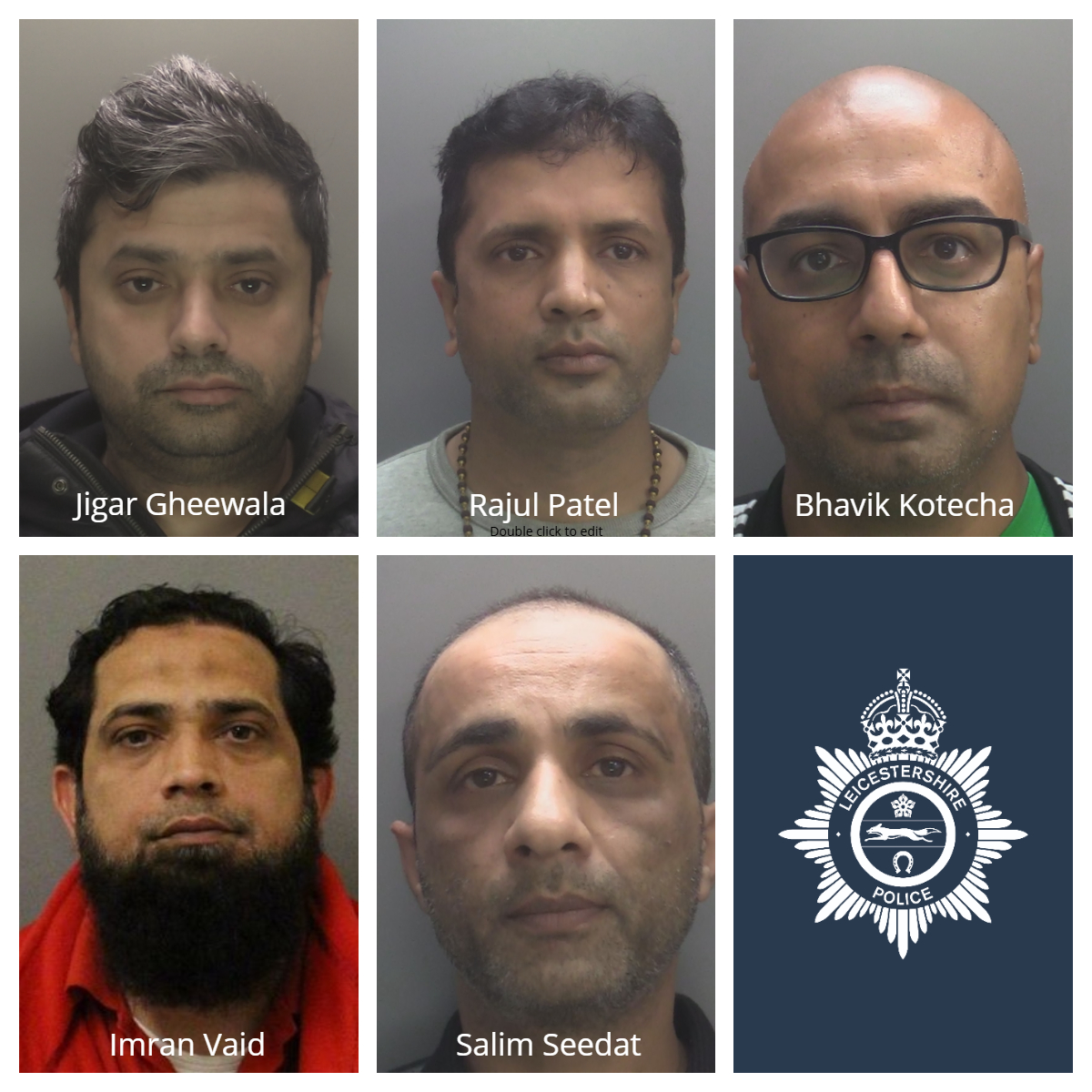
The defendants were systematic in their approach, using a token system to manage the cash deliveries and different individuals to make deposits across a number of bank accounts at multiple Post Office locations; they were careful to break the cash down into smaller amounts in an attempt to avoid suspicion.
The operation led to ten people being arrested and charged with conspiracy to commit money laundering.
Jigar Gheewala, 45, was at the top of the chain. A declared bankrupt at the time, he oversaw the whole operation. Criminal money from around the country would be couriered into Leicester under his instruction. His job was to launder it, in doing so, he directed others and was the sole point of contact with a crypto currency business, which was used to transfer the money into the crypto market.
Rajul Patel was Gheewala’s right hand man, acting as a facilitator and watchdog of the money laundering operation. When cash was handled, 50-year-old Patel was often there physically to make sure that all went well – usually hidden just around the corner.
He was the custodian of some of the bank cards used to pay in and launder the cash. He was also one of those with access to an address in Bristol Avenue in Leicester where some of the operation was run.
Bhavik Kotecha, 49, a Leicester businessman, used his company White Tiger Group Limited as a vehicle to launder the proceeds of the criminal enterprise. He handled cash deliveries on behalf of Gheewala and created hundreds of false invoices and paper trails through his business to cover the groups tracks.
Imran Vaid, 45, lived in London and had close ties to criminal cash that was couriered from London into Leicester. He was the organiser, enlisting the help of relatives in Leicester to receive cash deliveries. His fingerprints were found by detectives on packages of money seized during the enforcement. Vaid was also charged with possession/control articles for use in fraud.
Salim Seedat, 55, was a trusted member of the operation and a chief operative on the ground working closely with Patel and Gheewala. He was seen going into Post Office branches depositing bundle after bundle of cash, using a series of cards, some of which had post it notes attached with the PIN codes. Evidence also showed him recruiting individuals to supply bank accounts to the group.
David Nichols, 41, was a delivery man whose job was to transport cash from North England to the city where it would be laundered by the gang.
Vahid Shaikh, 60, like Seedat, was a trusted member of the operation, helping take delivery of cash, break it down into smaller amounts and make deposits into bank accounts.
Nearly a quarter of a million pounds in cash was intercepted as part of the operation, and further assets recovered and restrained including numerous properties, over £200k of gold bars, designer clothing and jewellery.

Gheewala, Nichols and Shaikh all pleaded guilty to the charges at previous court appearances.
Seedat pleaded guilty on the first day of the trial at Leicester Crown Court and the remaining six defendants stood trial.
On Wednesday (17 December) after a trial lasting nearly ten weeks, Kotecha, Patel and Vaid were found guilty of all the charges.
Two men and a woman who were also on trial were found not guilty.
Those convicted were sentenced as follows: -
- Jigar Gheewala, formerly of Leela Close, Countesthorpe, Leicester, was sentenced to 11 years and 10 months in prison. He was also banned from becoming a company director for 14 years.
- Bhavik Kotecha, formerly of June Avenue, Leicester, was sentenced to eight years and six months in prison. He was also banned from becoming a company director for 12 years.
- Rajul Patel, formerly of Bristol Avenue, Leicester, has been sentenced to eight years in prison. He was also banned from becoming a company director for 10 years.
- Salim Seedat, formerly of Earl Howe Street, Leicester, was sentenced to four years and nine months in prison.
- Imran Vaid, formerly of Hartley Avenue, East Ham, London, was sentenced to two years and two months in prison.
- David Nichols, of Elm Avenue, Thongsbridge, Kirklees, was sentenced to 10 months in prison, suspended for two years.
- Vahid Shaikh, of Heybridge Road, Leicester, failed to appear in court for sentencing and a warrant has been issued for his arrest.
Detective Constable Catherine Richards from the force’s Economic Crime Unit (ECU) was the investigating officer in the case. She said: “During the investigation I had been a detective within ECU for more than ten years and Operation Kilo must be one of the most complex and lengthy investigations I have been involved in.
“Vast amounts of money were laundered by this group, estimated to be more than £53m over two years. The money was used to purchase crypto currency and fund the lifestyle of the defendants.”
Financial Crime Supervisor Laura Panter, from the force’s Economic Crime Unit was the Deputy Senior Investigating Officer (SIO), she said: “This was a challenging investigation into a crime gang who were engaged in a complex money laundering scheme. Acting as a professional laundering service to individuals across the UK, they were organised and methodical in their approach, taking every opportunity they could to try and cover their tracks and keep their criminality under the radar.
“They took advantage of the Post Office network, recruited money mules, syphoned funds through businesses and utilised cryptocurrency as a tool to dissipate the criminal cash.
“Through our investigation, we were able to unpick their business model and present a case that laid their criminality bare. The evidence against Gheewala, the head of the group and a declared bankrupt, was so overwhelming that he had no choice but to plead guilty.
“In bringing this group to justice, we want to send a clear message that no one is untouchable, and anyone caught abusing the financial system or handling criminal proceeds will be brought to justice and face significant prison sentences.”
DC Richards and Laura Panter were also highly commended by the Judge for their first-class investigative work into what was an enormously complex investigation.
The defendants will now be the subject of future hearings under the Proceeds of Crime Act (POCA) which allow officers to apply to the courts to confiscate assets believed to be obtained as a result of criminality.
Anyone who has any concerns about individuals involved in money laundering or if you have any suspicions about illegal activity we would urge you to report it.
Contact 101 or report via www.leics.police.uk