
Over 70s targeted in a national campaign to tackle courier fraud offences
Main article content
A national campaign has been launched in a renewed warning to the public as courier fraud continues to evolve across the UK.
Criminals are using increasingly sophisticated and persistent tactics to cause financial harm to victims.
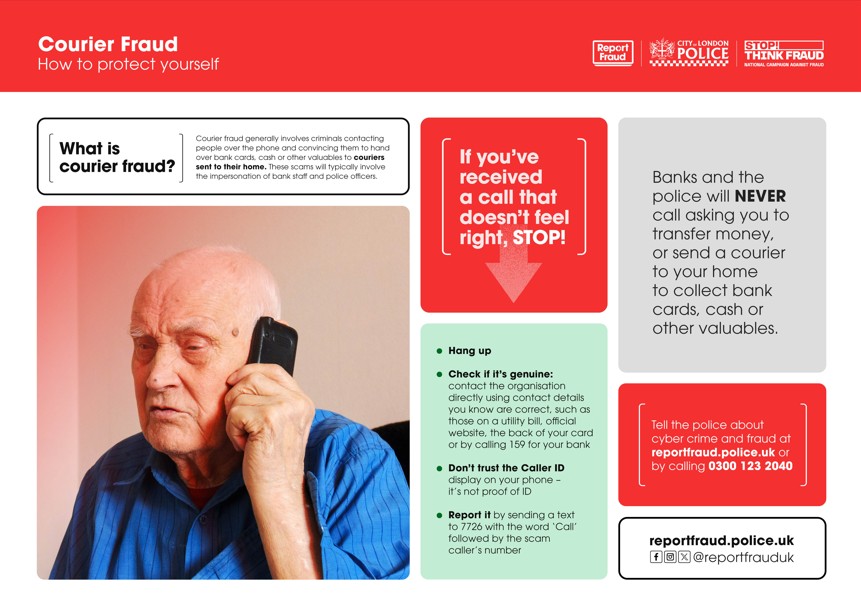
Typically, courier fraudsters target their victims by claiming to be a police officer or a member of staff from a victim’s bank and they often pressure people into making quick financial decisions to assist with fictious investigations.
Victims are told their account is at risk or that they are assisting with an investigation, before being instructed to withdraw money, purchase items, or disclose sensitive information. A courier is then sent to collect the items such as jewellery, cash, bank cards and PINs. In reality, this is the work of criminals and anything handed over is lost.
New figures released this week show nationally reports have increased by nearly 10 per cent year-on-year, rising from 1,721 in 2024 to 1,891 in 2025. Over the same period, total losses climbed from £19.5 million to more than £21 million, with the average amount stolen per victim now standing at £15,311.08, underlining the significant financial harm caused by each offence.
In Leicestershire 29 reports of courier fraud were received in 2025, with victims suffering losses of more than £65,000.
Nicole McIntyre from the force’s Economic Crime Unit, said: “These types of offences are borderless crimes, those responsible target victims not necessarily in their own area but across the country. We work closely with forces across the country to ensure any intelligence identified during investigations is shared.
“We support the national campaign and ask people to remain vigilant and to ensure elderly relatives, friends and neighbours are also aware of these types of offences and the steps they can take to reduce their chances of falling victim to them.
“Several warnings have been issued about these crimes but we know not everyone accesses social media or the internet, so we are asking the public to help us by informing others too.
“They should be advised that police officers would never contact them in this way. If they are called, they should disconnect the call straightaway and report the incident to the police using another telephone, as on some occasions calls can remain connected.
“Occasionally suspects will use local taxi or courier companies, who unknowingly accept the job. We would ask that people remain vigilant and if they are contacted to collect packages be mindful of who they are collecting these from if they have any suspicions to report them to the police immediately.”
Detective Superintendent Ollie Little, from the City of London Police, said: “Courier fraud is a cruel and calculated crime that targets trust, often focusing on older and or vulnerable people. Offenders are becoming more organised and persistent, sometimes maintaining contact with victims for days or weeks to maximise what they can steal.
“Criminals are also evolving their tactics, increasingly using messaging platforms such as WhatsApp and courier services to facilitate collections. These changes are making fraud harder to detect and emphasise the need for greater public awareness, particularly among those most at risk and their families.
“It’s vital that people know the warning signs and feel empowered to stop, question and verify before taking any action.”
A key feature of this threat is the disproportionate targeting of older people, particularly those aged 70 and above. This group makes up majority of victims, with those aged between 76 and 96 alone accounting for around 62 per cent of all reports.
Fraudsters often deliberately focus on older victims, exploiting trust in institutions such as the police and banks, as well as using pressure tactics, fear and urgency to manipulate them into complying with instructions.
A growing trend identified in 2025 involves the use of jewellery and gold to carry out high-value frauds. In many cases, victims are persuaded to visit multiple jewellers to purchase expensive items over a period of time before handing them to a courier. This method often results in the highest amount stolen and can involve repeat victimisation, with offenders maintaining contact to extract as much money as possible.
How to protect yourself from courier fraud:
- Transferring money: Your bank or the police will never ask you to transfer money to a safe account.
- Couriers: Your bank or the police will never send a courier to your home to collect bank cards, cash, or other valuables such as jewellery.
- Check if it’s genuine: Contact the organisation directly using contact details you know are correct, such as those on official websites, the back of your card or by calling 159 for your bank.
- Caller ID: Don’t trust the Caller ID display on your phone - it’s not proof of ID.
- Report suspicious calls: You can report suspected scam calls by sending a text to 7726 with the word ‘Call’ followed by the caller’s number.
If you think you have been a victim of fraud contact Report Fraud on 0300 123 2040 or via the website: reportfraud.police.uk.